
Oak Wilt
in Austin.
Oak wilt spreads silently through the soil, jumping root to root between live oaks at roughly 75 feet a year. By the time the first crown turns brown, the trees around it are already infected.
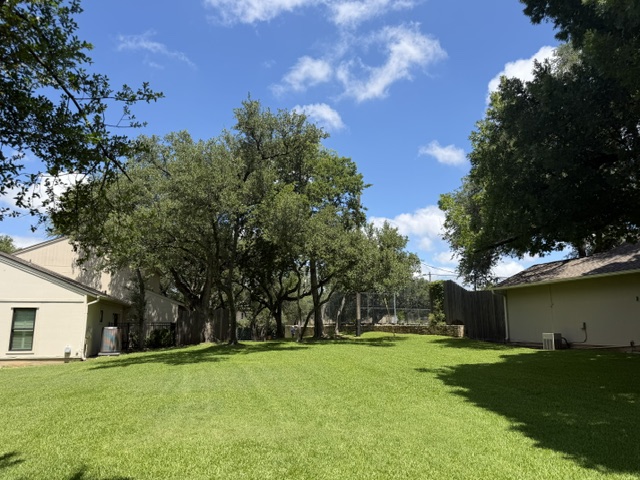
A healthy canopy and an oak in decline.
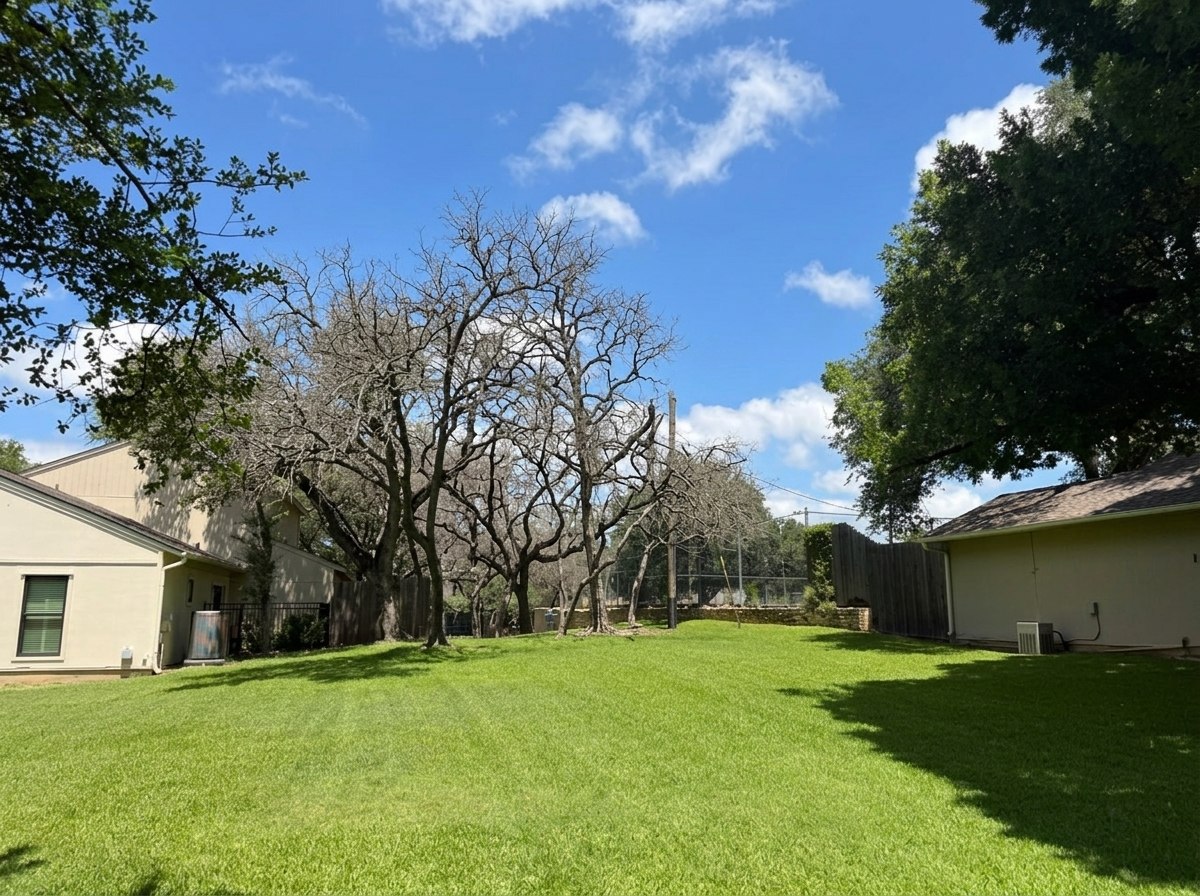
A fungus that turns a connected stand of oaks into a single, shared casualty.
Oak wilt is a lethal vascular disease caused by the fungus Bretziella fagacearum (formerly Ceratocystis fagacearum). It disables the tree's water-conducting system (xylem) by plugging the vessels with its own mycelium and triggering the tree to clog its own pipes. Red oaks are highly susceptible and die quickly, while live oaks spread it tree to tree through grafted roots.
That underground route is why it is so unforgiving. Live oaks rarely grow alone. Where their roots have fused, the disease passes tree to tree without ever surfacing, which is how a single infected oak becomes a moving front across an entire property.
It is a reportable disease in Texas. A suspected case is not a wait-and-see situation.
Two ways it travels.
Understanding both matters, because each route calls for a different response.
Beetles to fresh wounds
Sap-feeding nitidulid beetles feed on the sweet, spore-producing fungal mats that form under the bark of dying red oaks. Those contaminated beetles are then drawn to the fresh sap of a newly wounded or pruned oak, where they introduce the fungus.
Root graft to root graft
The devastating route for live oaks. The fungus travels through the vast, interconnected, grafted root systems between adjacent trees, creating expanding pockets of dead trees known as "centers."
Which oaks, and how fast.
How the disease progresses depends on the oak.
Red oaks
Spanish, Texas red, blackjack
- Rarely survive, and can die within 3 to 4 weeks of infection.
- Leaves turn pale green to bronze with rapid wilting.
- Grow spore mats under the bark, smelling of fermenting fruit, that start new infection centers.
Live oaks
Quercus virginiana
- Highly vulnerable because their roots graft together.
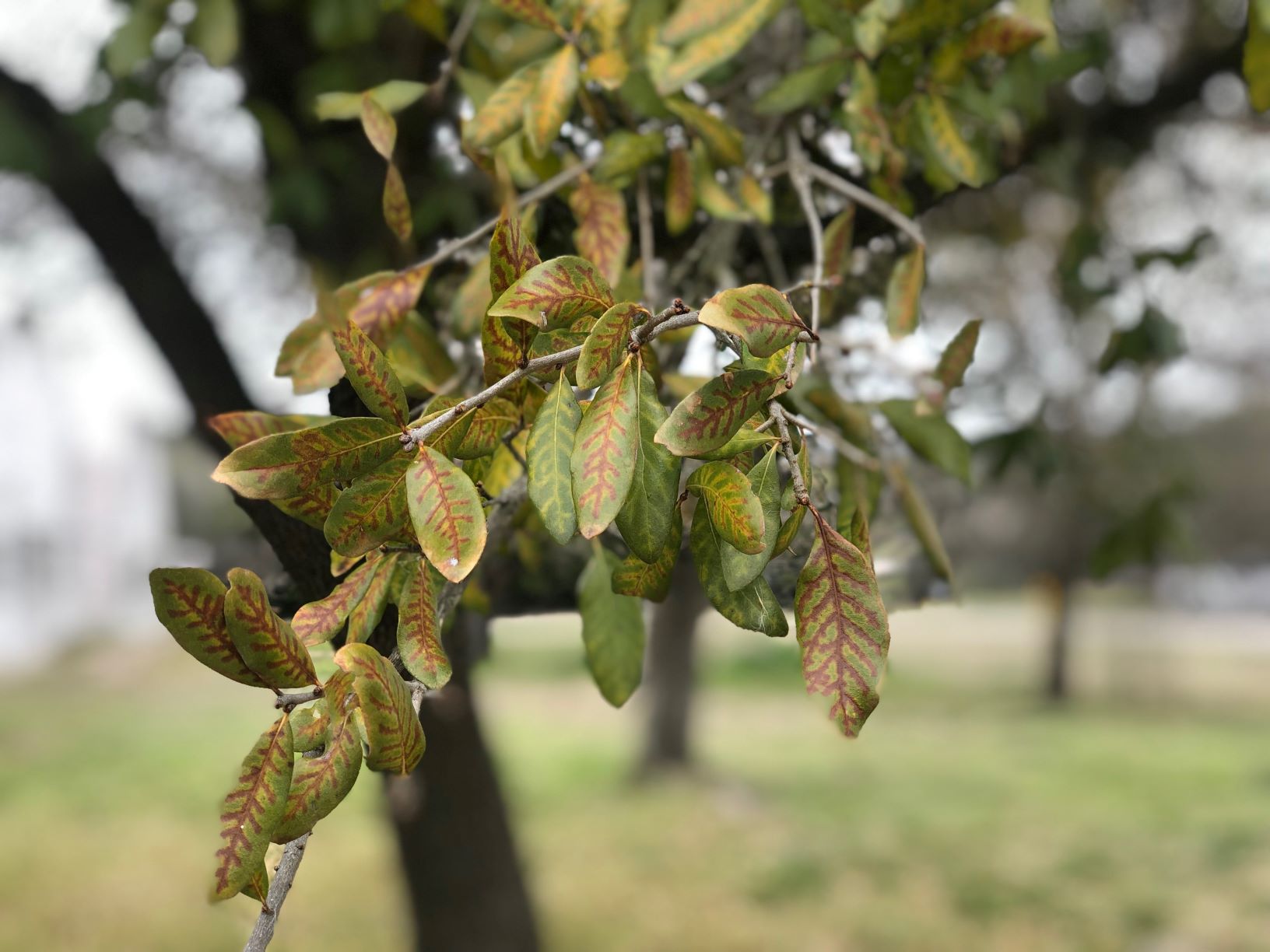
- Classic sign is veinal necrosis: veins yellow then brown while the rest of the leaf stays green.
- Carry the disease tree to tree underground.
White oaks
Post oak, bur oak
- The most resistant of the oaks.
- Decline slowly over years, and some recover.
Three signs, read together.
No single sign proves oak wilt. A confident call reads three things at once, the leaves, the pattern of dying trees, and the spore mats on dead red oaks. Any one alone can mislead. Together they tell the story, and they read differently depending on the oak.
The leaves
- Live oaks: veins yellow then brown while the tissue between stays green. Fallen leaves still carry that vein pattern, not a uniform brown.
- Red oaks: the whole leaf wilts and browns from the tip and edges inward, and fast.
- White oaks: vague, scattered browning that is easily mistaken for ordinary stress.
The pattern of death
- Live oaks die in an expanding pocket, a "center" that radiates outward through grafted roots, a ring of newly browning trees around a dead core.
- Red oaks usually drop one tree, or a small cluster, in a matter of weeks.
- White oaks decline slowly and scattered, over years rather than weeks.
Fungal mats
- Only red oaks grow them, only after they die, and mostly in the cool damp of spring.
- The mat's pressure splits the bark in narrow vertical cracks.
- Pry the bark back and you find a gray-to-tan, spongy pad that smells sweet, like fermenting fruit.
- That odor draws the beetles that carry spores to the next fresh wound. Live and white oaks never form mats.
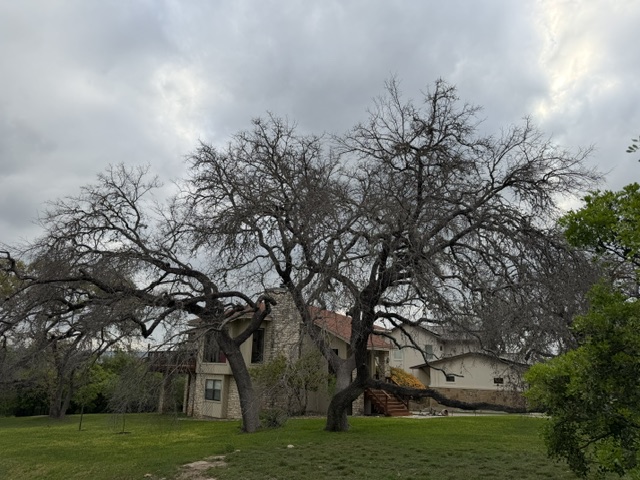
By the time decline is obvious from the street, the infection has usually been moving below ground for a while. The earlier a suspected case is confirmed, the more of the surrounding stand there is to protect.
A mat is the one nearly certain sign in the field, and the moment to get ahead of the beetles before they reach the next yard. Even so, none of these three is proof on its own. Oak wilt is a reportable Texas disease, so a suspected case calls for a certified arborist and a lab result routed to the state diagnostic lab, not a wait-and-see.
Confirm first. Then contain.
There is no home remedy for oak wilt, and guessing wastes the one resource that matters most here, which is time. The work follows a disciplined order. See how oak wilt treatment is priced in Austin →
On-site evaluation
A qualified arborist walks the property, reads the canopy and the pattern of decline, and assesses how the affected oaks are connected to the rest of the stand. Suspicion is not diagnosis.
Certified lab confirmation
Oak wilt is easily confused with look-alikes such as bot canker and bacterial leaf scorch, so the plan waits on a certified laboratory result, not a hunch. Samples are submitted for diagnostics, and reportable findings are routed to the Texas Plant Disease Diagnostic Lab.
Break the underground path
Containment centers on severing the root grafts ahead of the infection front, typically by trenching, so the fungus cannot keep passing from oak to oak through the network.
Protect what is still healthy
High-value oaks in the path may be candidates for preventive fungicide treatment, delivered as targeted micro-injections directly into the tree, paired with strict wound-timing discipline so fresh cuts never invite the beetles that carry it above ground.
There is no cure. There is discipline.
Once a tree is heavily infected, oak wilt can't be reversed. Management leans hard on prevention and fast, confirmed containment.
Don't prune in the high-risk window
Avoid pruning or wounding any oak between February 1 and June 30 in Central Texas, the season when spore-carrying beetles are most active and most drawn to fresh cuts.
Paint every wound, immediately
If an oak must be cut, seal the wound right away with pruning paint or wound dressing. Every cut, year round, within minutes.
Sever the root connections
Deep trenching, roughly four feet deep and eight inches wide with a rock saw, breaks the grafted roots between live oaks and halts the underground spread.
Protect healthy oaks with injection
The fungicide propiconazole can be micro-injected into healthy, non-symptomatic live oaks near infected trees to protect them before they catch it. It is re-applied every two to three years, and it can't save a tree that is already infected or past roughly a third of canopy loss.
Remove infected red oaks
Promptly remove dead red oaks and chip, bury, or burn the wood so the fungus can't form the spore mats that start new centers.
Five of the industry's most demanding qualifications.
Oak wilt is one piece of it. The same arborist looking at your trees holds the certifications to evaluate them, document the risk, and stand behind the recommendation.
ISA Certified Arborist
TX-5089A
 Tree Risk Assessment Qualified
TRAQ
Texas Oak Wilt Qualified
TOWQ-685
Tree Risk Assessment Qualified
TRAQ
Texas Oak Wilt Qualified
TOWQ-685
 Wildfire Risk Reduction Qualified
TXWWRQ-200
Wildfire Risk Reduction Qualified
TXWWRQ-200
 Prescription Pruning Qualified
ISA
Prescription Pruning Qualified
ISA
Austin and the Hill Country.
Common questions.
I think my oak has oak wilt. What should I do today?
Do not cut, prune, or remove the tree yet, and do not let anyone else. Paint over any fresh wounds immediately, keep any cut wood on site and covered, and get a Texas Oak Wilt Qualified arborist out to confirm it before the fungus reaches your other oaks. The wrong cut at the wrong time makes it worse.
How fast can oak wilt kill an oak in Austin?
Red oaks can be dead within weeks once symptoms appear. Live oaks usually decline over three to six months, but because Austin live oaks share root systems, an infected tree pulls its neighbors down with it, so the yard-level clock is shorter than any single tree suggests.
Can the rest of my oaks still be saved?
Often, if you move quickly. A deep trench can sever the shared roots that carry the fungus underground and stop it from spreading, and high-value live oaks can be protected with fungicide injection. Confirmation and a containment plan come first, because oak wilt is a reportable Texas disease.
Tell me what you are seeing.
Send a few details, or call directly. You will get a straight answer on whether your oaks need an urgent, on-site look.